
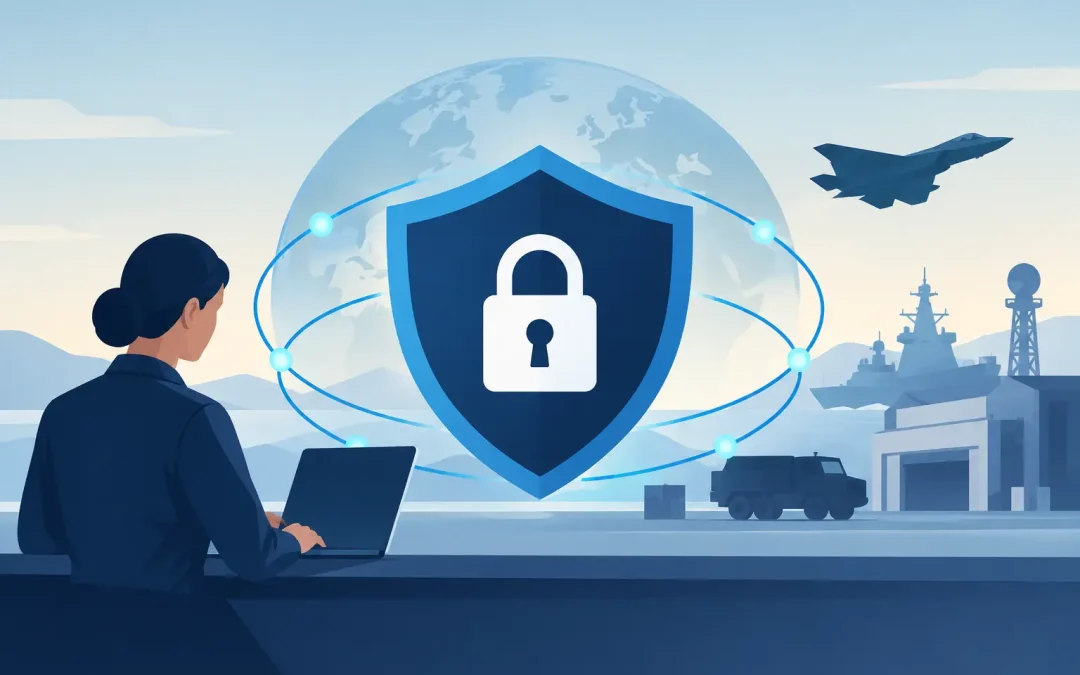
A compromised subcontractor account should not become a path into controlled unclassified information, engineering repositories, program communications, or a prime contractor’s environment. Yet too many security programs still assume that a user who clears the VPN, signs in through Microsoft 365, or works from a known office has earned broad trust. Zero trust for defense contractors rejects that assumption.
This is not a product category and it is not a compliance slogan. It is an operating model: verify each request, limit what a verified identity can reach, continuously evaluate risk, and preserve records that can withstand customer, regulator, and incident-response scrutiny. For contractors handling CUI, sensitive program data, export-controlled material, or mission-critical operational systems, that distinction is not academic.
Why Defense Contractors Cannot Rely on Perimeter Trust
Defense industrial base (DIB) environments are complicated by design. A contractor may have a small internal IT team, multiple government and commercial tenants, remote engineers, field personnel, legacy applications, outsourced accounting, specialized manufacturing systems, and data shared with primes and subcontractors. The attack surface is not one network. It is a chain of identities, devices, cloud services, vendors, and data flows.
Traditional perimeter security fails when one of those links is compromised. An attacker who obtains valid credentials through phishing, business email compromise, password reuse, session theft, or an unmanaged personal device can often move farther than the business intended. Flat networks and broad group permissions turn a single identity failure into an enterprise event.
A zero trust architecture constrains that blast radius. It asks whether the user is who they claim to be, whether the device meets policy, whether the requested resource is appropriate for that user’s current role, and whether the behavior makes sense in context. Access is not granted because someone was trusted yesterday.
That matters especially where contractual obligations and security frameworks overlap. NIST SP 800-171, CMMC requirements, export controls, prime-contractor flow-downs, insurance conditions, and customer audits all create pressure. But a contractor should not mistake passing an assessment for controlling real risk. A policy document does not stop a stolen session token. An annual access review does not prevent a terminated employee from reaching a cloud repository if offboarding failed.
Zero Trust for Defense Contractors Is a System of Decisions
The strongest programs are built around the actual mission, data, and operating constraints of the contractor. They do not begin by buying every tool a vendor can sell.
Start with the assets that can change the outcome
Identify where CUI, technical data, contracts, pricing, source code, manufacturing files, personnel records, and privileged legal material actually reside. Many organizations can name their primary file share but cannot explain how information moves between email, collaboration platforms, cloud storage, personal devices, backup systems, and outside partners.
That uncertainty is a security problem. It is also an investigation problem. If a suspected disclosure occurs, leadership needs to know what data was accessible, by whom, from what device, and whether it left the environment. Without disciplined logging and retention, those answers become guesses.
Data mapping should include the systems that support the data, not just the data itself. A cloud identity platform, endpoint management console, remote access gateway, help desk account, or backup administrator may hold the keys to critical information even if it stores no CUI directly.
Treat identity as the primary control plane
Most breaches begin with identity. Zero trust therefore requires more than requiring multifactor authentication at initial sign-in. Contractors should enforce phishing-resistant authentication where appropriate, remove shared accounts, control privileged access tightly, and apply conditional access based on user role, device health, location, risk signals, and application sensitivity.
Least privilege sounds simple until it meets a real engineering, finance, or program-management workflow. The answer is not to issue standing administrator rights because access requests are inconvenient. Use role-based access where roles are stable, time-limited elevation where privileged work is occasional, and documented exceptions where mission needs truly demand them.
The trade-off is operational friction. An engineer on a deadline may experience added prompts or a blocked connection from an unapproved device. That is not proof that the control is wrong. It is evidence that security leadership must design access around legitimate work, communicate the reason for controls, and provide a fast escalation path staffed by people who understand the stakes.
Make device trust meaningful
A valid user on an unmanaged or compromised endpoint is not a trusted request. Device posture should be evaluated before access is granted to sensitive resources. At a minimum, that typically means supported operating systems, encryption, endpoint detection and response, current patching, screen-lock controls, centralized management, and the ability to isolate a device when risk is detected.
Bring-your-own-device arrangements deserve particular scrutiny. They may be workable for low-risk functions, but they are difficult to defend when personnel can download program data, synchronize email, or access administrative portals from devices outside organizational control. If a contractor permits personal devices, access should be deliberately constrained rather than silently tolerated.
Segment systems and limit lateral movement
Network segmentation remains essential. Zero trust does not mean the network no longer matters. It means network location alone is insufficient as proof of trust.
Separate user environments from servers, administrative systems from standard productivity tools, and sensitive enclaves from general corporate resources. Require explicit paths between segments, log those connections, and limit who can administer the systems that enforce the boundaries. A manufacturing environment, laboratory system, or legacy application may require different controls than a modern SaaS platform. The architecture must account for that reality without leaving the exception invisible.
Build Evidence Into the Architecture
For a defense contractor, security controls must be operationally effective and defensible. When an incident, audit, dispute, subpoena, or internal investigation arrives, leadership should be able to reconstruct what happened without scrambling to preserve overwritten logs or explain undocumented administrator access.
That requires centralized logging, synchronized time sources, meaningful retention periods, protected audit trails, and tested incident-response procedures. Logs should capture identity events, privileged activity, endpoint alerts, file access where feasible, cloud administrative changes, and remote-access activity. Collection alone is not enough. Someone must monitor, investigate, and escalate meaningful signals.
Insider risk requires the same discipline. Most concerning activity is not cinematic sabotage. It may look like unusual downloads before a resignation, repeated attempts to access a restricted folder, forwarding sensitive material to personal email, or a manager approving access that no longer matches an employee’s duties. Context matters. So do preservation procedures, chain of custody, and coordination with counsel when the matter may lead to litigation or regulatory exposure.
A ticket-driven IT model is poorly suited to this work. It may close an alert, reset an account, and move on. A mature response determines scope, preserves evidence, contains the threat, documents decisions, and gives executives and counsel facts they can act on.
Avoid the Common Zero Trust Failure Modes
The most common failure is treating zero trust as a single implementation. Deploying MFA, a secure access service edge platform, or endpoint protection can improve security, but none of those controls alone creates zero trust. Architecture, governance, monitoring, and human operations must work together.
Another failure is overengineering. Small and mid-sized contractors do not need to mimic the tool stack of a major prime to reduce material risk. They do need clear ownership, hardened identity controls, managed endpoints, sensible segmentation, tested backups, and continuous visibility. The right program is proportionate to the data, contractual obligations, threat profile, and available internal capability.
Finally, do not leave exceptions unmanaged. Legacy systems, urgent subcontractor access, travel, acquisition activity, and classified-adjacent operations can create legitimate deviations from standard policy. The problem is not that exceptions exist. The problem is when no one records the business justification, compensating controls, owner, and expiration date.
What Senior Leadership Should Demand
Boards, general counsel, COOs, and security leaders should be able to ask direct questions and receive direct answers. Which identities have privileged access? Which devices can reach CUI? Where can sensitive data be downloaded or shared externally? How quickly can access be revoked during a termination? What evidence would be available if a prime contractor reports a possible compromise?
If the answers depend on several administrators searching disconnected consoles, the program is not ready. If they rely on assurances from a vendor rather than tested evidence, the program is not ready.
Reliant Management helps organizations build security environments that are designed for this level of scrutiny: controlled access, monitored systems, defensible evidence, and senior-level accountability. The objective is not to create more bureaucracy. It is to ensure that one compromised identity, one unmanaged device, or one overlooked vendor connection does not become the event that puts a contract, reputation, or mission at risk.